Tuesday, 29 March 2011

Perforation

Collectors into stamp varieties normally focus on watermark and perforation of the stamps, though other aspects of the stamps such as fluorescent mark, paper type, gum (for mint stamp only) etc. are also considered. For Malaysia recent stamps, the varieties are mainly on watermark and perforation. I talked about watermark variety some time ago, and you may click here to read about my writing on watermark.

So, what is actually perforation? Perforation of a stamp is the pin holes on stamp sheets created by perforator (comb) so that the stamps could be parted into single pieces easily. If without perforation, stamp sheet has to be cut into single pieces by a pair of scissors or knife. If one pays extra attention on these pin holes (perforation), one would notice that some stamps have pin holes very close to each other and some have pin holes more distant to each other. The distance between two pin holes is said perforation size. The standard way of describing perforation size is the number of pin holes for a distance of 2 cm. If there are 12 pin holes for a distance of 2 cm, the perforation size is said P12. Of course, there is a special instrument (perforation gauge) to measure perforation size. One needs to lay the perforation gauge on a stamp, and then move the perforation gauge up or down along the stamp until the lines of the gauge overlaid the distance of pin holes perfectly. The reading of perforation size is given on the side of the gauge.

a perforation gauge


perforation size is P13.5

perforation size is P12


Of course, one could discover perforation varieties by overlaying two stamps of different perforation sizes. The pin holes of these stamps are just mis-aligned as shown in the figure below.

two stamps are overlaid on each other to show the mis-aligned pin holes indicating different perforation sizes of the two stamps


The perforation of a stamp is normally written by a formula below:
P a x b

where,
P is the abbreviation of “Perforation”
a is the value at the top/bottom side of a stamp
b is the value at the right/left side of a stamp

If the top/bottom reading is 12 and the right/left side reading is 14, then the correct way of writing perforation size is P12x14. If both the top/bottom and right/left sides are 12, then it could be written as P12x12 or just P12. The higher the perforation value the closer the pin holes, meaning that the stamps are easier to be separated. Malaysia recent commemorative stamps normally have four perforation values – P12, P13.5 P14 and P14.5. On the other hand, the Malaysia definitive stamps (agro-based product, fruit, garden flower and bird) have perforation values P12, P13.5, P13.75, P14, P14.5 and P14.75.


Monday, 28 March 2011

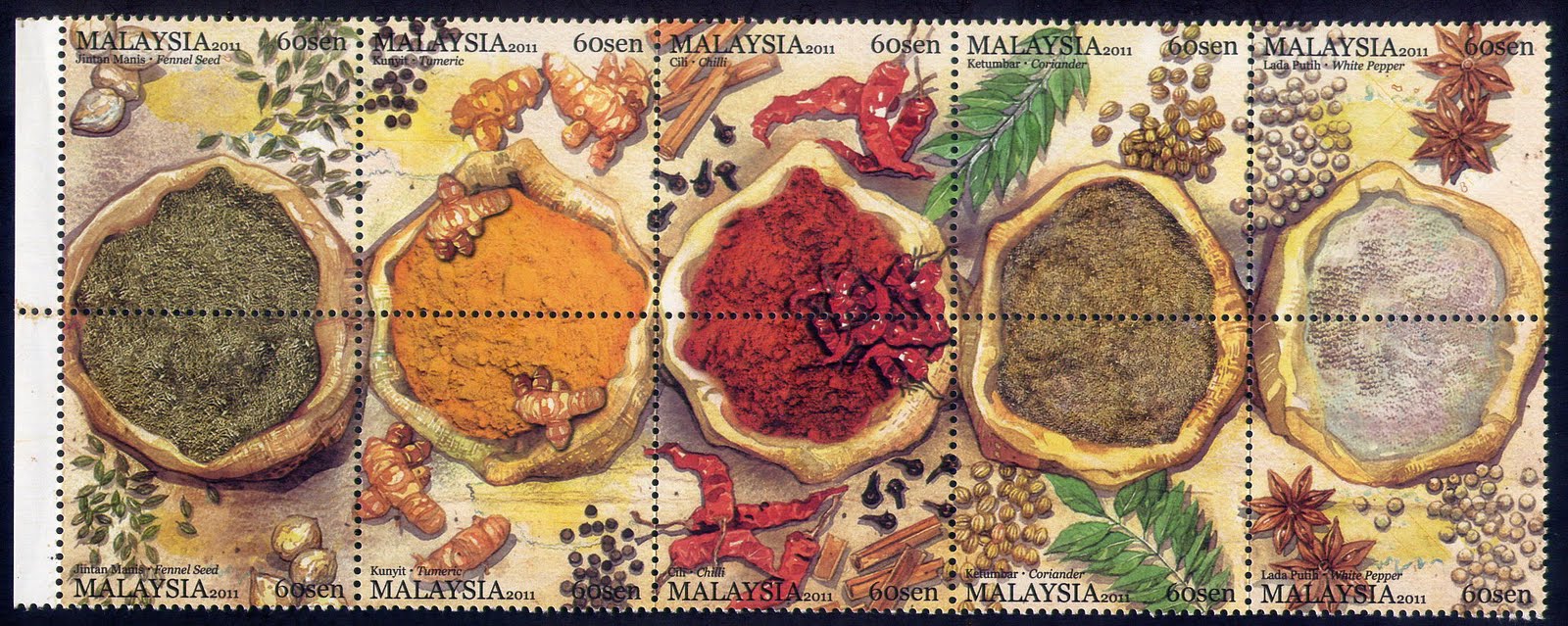
2011 - Spices

Pos Malaysia released new stamps on March 28, 2011. The stamp issue depicts spices normally used in Malaysian cooking. The stamp set contains three denominations - 60 sen, 90 sen and RM1. Besides, a miniature sheet (RM3) and a stamp booklet (RM6) were also issued. The miniature sheet contains two stamps - one with denomination RM1 and the other one is RM2. On the other hand, the booklet contains 10 different stamps with 60 sen each.

The common watermark for the stamp set is SPM inverted and for the miniature sheet is SPM sideway down. On the other hand, the booklet stamps have two different watermarks - SPM sideway up and SPM sideway down. Both the watermark varieties of booklet stamps should be in equal number.

The 60 sen stamp from the stamp set portrays cinnamon or in Malay kayu manis. I told the postal staff at the philatelic counter - benda ini macam kayu balak lah (this thing looks like timber logs). A collector/customer next to me told me that he just wanted to say the same thing... hahahahahaha


stamp set

miniature sheet

stamp booklet - the front cover

stamps from booklet


Thursday, 24 March 2011

A Beautiful Cover from Wallis and Futuna

Wallis and Futuna - 2 March 2011

Stamp Sheets - Thailand

Many postal authorities in the world are issuing stamp sheets in format of 20-stamp or 10 stamps aiming for collectors. Thai Post has no difference in this aspect. I acquired the below beautiful stamp sheets of Thailand depicting carnivorous plants issued in 2006. The stamp are printed in format of 20-stamp-sheet. I just love these carnivorous plant stamps, and they look fabulous in format of 20-stamp sheet.


Two Covers from Thailand


Wednesday, 23 March 2011

Paquebot Mail

I've got my first paquebot mail. What is actually paquebot mail? A paquebot mail is mailed on a ship, and then dropped off at an overseas port for dispatch. So, the below postcard was posted at sea on R.M.S. St. Helena (a small ship; R.M.S. stands for Royal Mail Ship), and the postcard entered the postal system at Jamestown, St. Helena on February 23, 2011. The R.M.S. St. Helena visits St. Helena, Cape Town, Ascension, Tenerife and Portland.


Still on Stamp Sheets

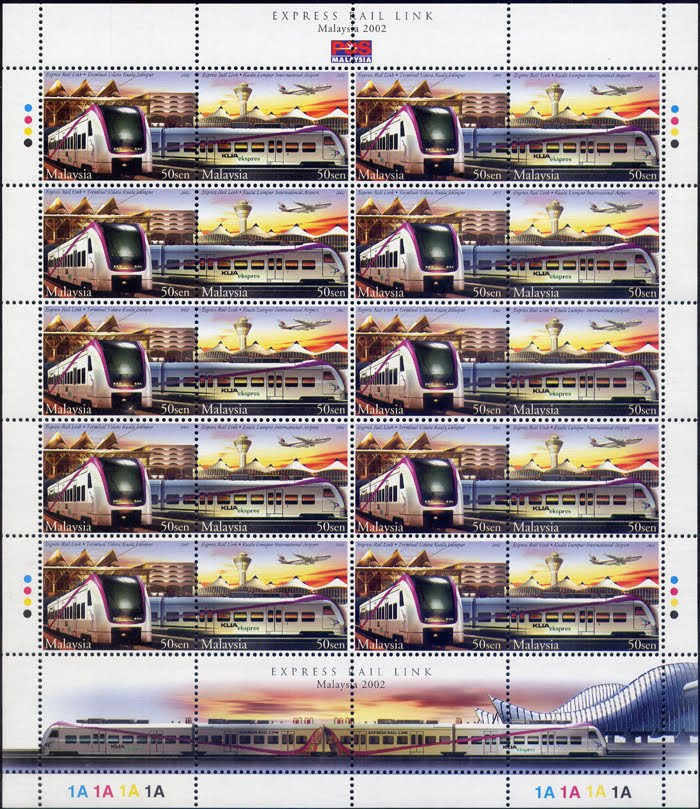
Stamp sheets are always beautiful, and collecting them is surely not cheap. A visitor "Money Talk" to my blog commented that financial factor is the hindrance for collecting stamp sheets. Well, she/he takes the word out of my mouth, and I do not need to elaborate any longer. The beauty of stamp sheets, however, sometimes could be too much for collectors to resist. By just looking at the two stamp sheets below depicting the trains issued in 2002, many collectors could be drooling.... hehehehe